The quiet way careers lose relevance in 2026 (and what still protects you)
Feb 07, 2026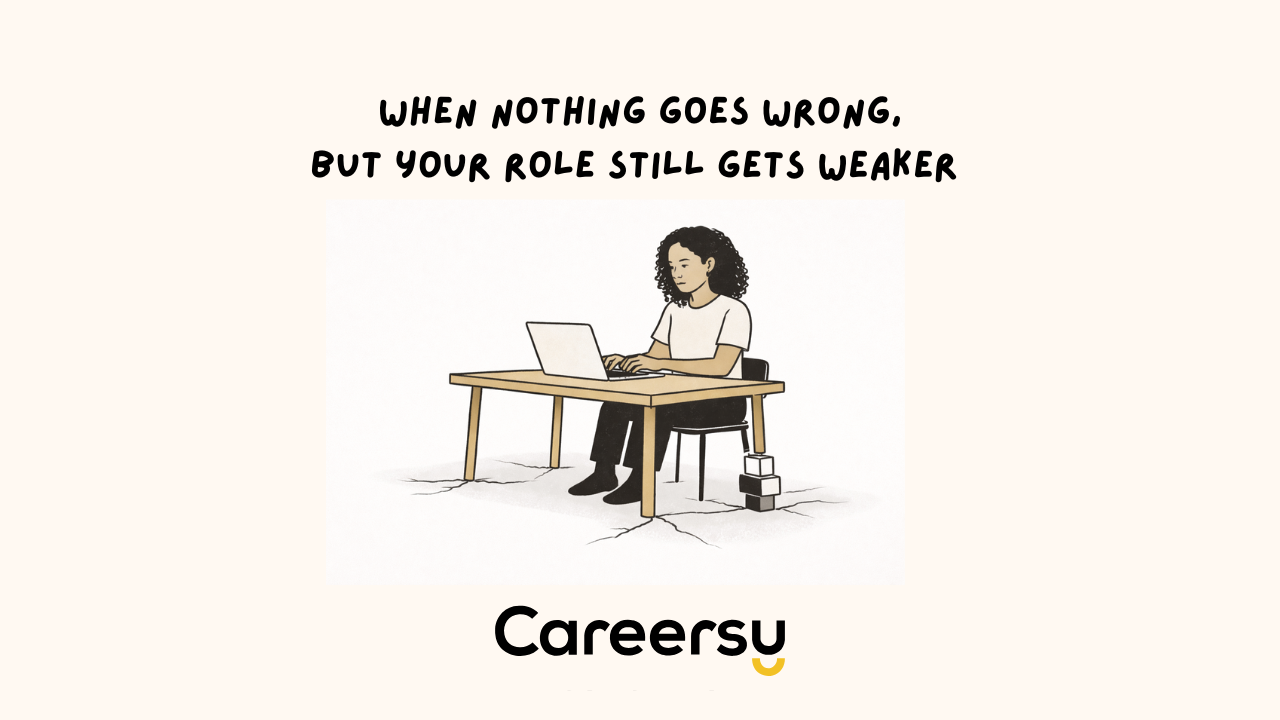
When nothing goes wrong, but your role still gets weaker | *Reading time: 6 minutes
Most people are watching for the wrong signal.
They’re waiting for a layoff. A reorg. A moment when something clearly breaks. That made sense for a long time. Career risk used to arrive as events.
But that’s no longer how risk mostly shows up.
In 2026, the bigger threat won’t be just losing your job. It will be staying in it while the role quietly loses weight. Nothing dramatic happens. Your title remains. Your calendar stays full. What changes is harder to see: your work becomes easier to replace and harder to justify.
That slow drift is what most people aren’t preparing for.
What makes this moment confusing is that most public commentary isn’t actually wrong, it’s just incomplete. You’ll hear that AI isn’t the main driver of layoffs, that jobs are evolving rather than disappearing, that the market feels strange but not broken. All of that can be true at the same time people feel persistently uneasy. I know I do.
The missing explanation is that the old safety signal, having a job, no longer correlates cleanly with future leverage. Employment used to imply durability. Now it mostly implies temporary alignment. That gap between “nothing bad happened” and “something still feels off” is where the real risk lives.
There’s a belief many capable people still operate under: if I do good work and stay valuable, I’ll be fine. That belief isn’t naïve. It’s just anchored to an older system.
Performance still matters, but it’s no longer the deciding variable. Under pressure, organisations don’t ask who is good or respected or delivers. They ask something colder: what does the system still need in this form? Sometimes the answer is simply less than before.
Not because anyone failed. Because the shape of the work changed.
AI didn’t make talented people worse at their jobs. It changed how work is distributed inside roles. Tasks that used to justify headcount are cheaper now: drafting, analysis, first-pass thinking, coordination. What didn’t become cheaper is judgment under constraint.
That’s why you’re seeing something unsettling: exceptional people being laid off anyway. Not as a moral judgment. As a systems outcome. The organisation no longer needs that configuration of value.
For a while, I did what most rational people did. I learned the tools. Stayed close to AI. Helped others adapt. Then I watched people get laid off who were genuinely excellent at what they did. Not coasting. Not outdated. Not invisible.
That’s when it clicked: your role, your impact, even your reputation can no longer fully protect you. Not because they don’t matter. But because systems optimise differently once pressure appears.
A useful way to think about this is PAR: Problem, Action, Result. I usually share this as a CV and interview framework, but it’s more revealing as a relevance test.
Problems justify existence. Actions show effort. Results explain why something mattered. AI can help with actions. AI can help produce results. AI cannot own the problem. Problem ownership is where relevance is now concentrating.
Many roles are drifting into a fragile shape. The problem is defined elsewhere. The action is increasingly automated. The result is measurable but interchangeable. Nothing is “wrong.” Reviews stay fine. But nothing is uniquely yours.
This is how people become removable without being underperformers.
Here’s a simple test. Take one recent piece of work and ask yourself: did I help define the problem, or did I execute against one someone else owned? Did I make a real trade-off, or just move something forward? Did this change a decision or direction, or did it mainly produce output?
If your contribution mostly begins at action, that’s not a personal failure. It’s a risk signal you need to pay attention too.
Preparation doesn’t mean learning more tools. It means shifting where your value sits. Take responsibility for at least one decision, not just execution. Improve or simplify one workflow instead of adding process. Share your reasoning, not just your output. And maintain quiet optionality: keep your story current, stay connected outside your company, and be able to explain your value without relying on your title.
This isn’t about leaving. It’s about not being trapped.
2026 won’t be kind or cruel. It will be indifferent. It will reward roles that reduce uncertainty and quietly shed those that don’t. The people most surprised by this won’t be the least skilled. They’ll be the ones who mistook stability for safety.
One question worth sitting with:
if your role stayed exactly the same for the next 18 months, would that make you more relevant or less?
That answer matters more than any headline ever will.
P.S. If you want practical ways to apply this, I explore them inside my community (here). It’s a small group (31 members) focused on clear thinking about work. No pressure. Just an option if this resonated.
Stay Sharp Between Applications
Join 1,000+ ambitious tech pros and get one practical, recruiter-backed career tip every Sunday to help you land interviews, negotiate offers, and grow in your role.
No fluff. No spam. Just real advice from inside the hiring room.
We hate SPAM. We will never sell your information, for any reason.