How to tell whether it’s time to look for a new job and how to begin without burning everything down
Jan 25, 2026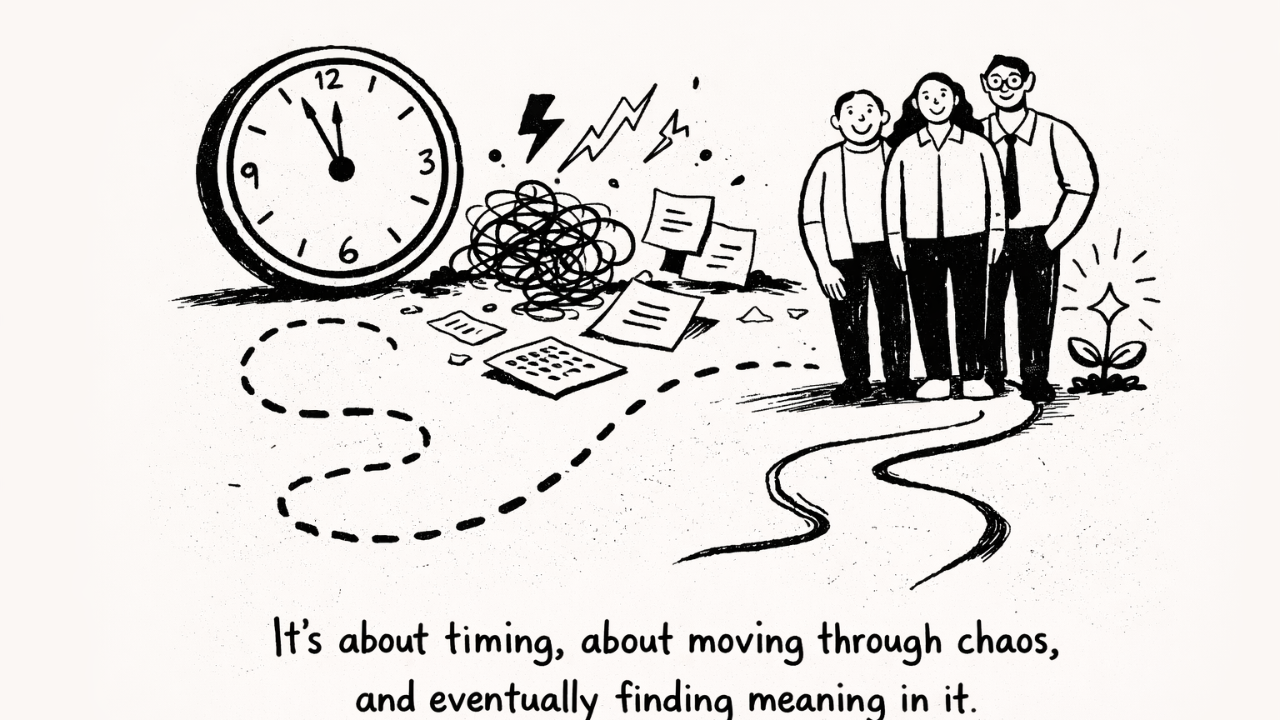
Hello reader,
Firstly, thank you for taking the time to read this.
This is a 6-8 minute essay about a feeling many capable people quietly carry, the sense that work has started to feel heavier than it should. If that’s you, my goal here isn’t to push you toward quitting or staying. It’s to help you move out of uncertainty and into clarity, with a way to act that doesn’t blow up your life or drain your energy.
There’s a particular kind of tired that doesn’t come from working too much.
Your calendar is full. Slack keeps moving. On paper, things are fine. But your curiosity has dulled. Small tasks feel heavier than they should. You notice yourself procrastinating in ways you didn’t six months ago.
And somewhere in the background, a quiet question starts looping. Is this still the right place for me?
Most people don’t ask that question because they’re reckless or ungrateful. They ask it because they’re paying attention. But what usually follows isn’t action, it’s limbo.
You keep showing up, half committed. You don’t want to blow up a stable situation, especially in a market where hiring feels uneven and unpredictable. At the same time, you can’t fully invest in the role you’re in, because part of you is already imagining an exit.
That half in, half out state is one of the most draining places a career can get stuck. Performance dips. Confidence erodes. The job starts to feel worse than it objectively is, not because it changed, but because your relationship to it did.
I’ve lived in that state more times than I’d like to admit. For years, it showed up like clockwork. A creeping sense that I should be learning faster, growing more, contributing at a higher level. Weeks of internal debate. Very little forward motion.
What finally broke the pattern wasn’t confidence or bravery. It was structure.
Instead of asking “Should I leave?”, which is almost impossible to answer honestly, I learned to ask a narrower, more useful question. What do the real options in the market actually look like right now?
That reframing matters because imagination is a terrible career advisor. When you’re tired, your brain invents a hypothetical better job that conveniently fixes whatever feels uncomfortable today. More impact. Better manager. More appreciation. Fewer meetings.
But careers don’t change through imagined alternatives. They change through comparison. Once I had a way to compare my current role against real, concrete options, the anxiety started to lose its grip.
The first constraint I put in place was time.
Open ended job searching is corrosive. It seeps into evenings, weekends, and mental bandwidth. So instead, I gave myself a defined window, usually about eight focused weeks, to seriously explore what else might be out there.
That deadline did two things at once for me. It forced me to move from passive wondering to active learning. And it gave me a clean stopping point. If I reached the end of that window without finding anything meaningfully better, I could stop searching and consciously recommit to my current role for another stretch, without resentment.
Paradoxically, knowing I wasn’t forever stuck made it easier to stay.
But before talking to anyone externally, I learned to pressure test whether what I was feeling was actually a signal, or just noise.
Burnout, boredom, misalignment, and under recognition all feel similar in the body. But they require different responses. Sometimes the job is wrong. Sometimes the role has quietly drifted. Sometimes the environment changed faster than you did. And sometimes you’re just depleted.
One useful question I started asking myself was this. If this role stayed exactly the same for another year, would I regret staying, or just be uncomfortable for a while? Regret points to misalignment. Discomfort often points to a solvable problem.
Only after sitting with that did it make sense to work on my narrative.
Early in my career, a Solution Architect from Amazon who was initially a candidate I wanted to place, and later became a friend, asked me to prepare a short deck about who I was, what roles I’d recruited, and what I’d learned. Not a resume in slides, but a story. That exercise turned out to be more useful than any template I’ve used since.
When you’re inside your own career, your accomplishments feel obvious and fragmented. You remember the messy parts. The trade offs. The things that almost worked. Research consistently shows that many people, especially women, systematically undervalue their own contributions.
What helped me get unstuck was borrowing perspective.
I asked a handful of trusted colleagues, former manager, and my Solution Architect friend to write a few sentences about what they saw as my strengths and impact. I reread old performance reviews and pulled out recurring themes. The language they used was clearer, stronger, and more generous than anything I would have written myself.
Over time, repeating that narrative changed how I showed up in conversations. Confidence stopped being something I tried to summon and became something I could reference. Only then did it make sense to get specific about what I was optimising for next.
Most job searches fail quietly because everything is treated as equally important. Title, compensation, scope, flexibility, growth, status. When all variables matter, none of them guide decisions.
The more effective, and uncomfortable, approach is to choose one or two factors that matter right now, given your life and constraints, and let the rest be secondary. Not forever. Just for this decision.
Constraints matter more than preferences. Financial runway, visa status, caregiving responsibilities, health, geography. These shape what “good” can realistically look like. Naming them upfront reduces self judgment later.
Of course, none of this works if the search never makes it onto your calendar.
Your current job will always expand to fill your available time. So if exploring matters, it has to be operationalised. For me, that meant blocking a consistent weekly window, the same afternoon every week, reserved for conversations, outreach, or preparation. I had an hour and half blocked for this.
The predictability mattered more than the volume. It meant progress happened even on quiet weeks, and momentum didn’t depend on motivation.
As interviews began, another shift made a disproportionate difference.
I stopped treating interviews as auditions and started treating them as mutual evaluations.
That doesn’t mean being casual or under prepared. It means anchoring yourself in the belief that fit goes both ways. If you have to perform a version of yourself that isn’t sustainable to get an offer, the cost will be paid later, quietly, through burnout. Plus, interviewers can sense or feel if you’re putting on a mask or show. Being yourself helps you built true rapport with the other person, which is key in a interview setting. People want to work with people they like, especially in Australia. The question isn’t “Can I convince them?” It’s “Does this environment want the kind of work I actually do well?”
One thing I wish I’d done earlier was define exit criteria, not just hopes. What would make a new role clearly better than my current one? What compromises am I explicitly unwilling to make? Writing those down reduced second guessing when emotions ran high.
I also learned not to freeze my life while searching.
Job searches are stressful and emotional, but putting everything else on hold only amplifies the pressure. Keeping up normal rhythms, friendships, movement, meaningful work, made the uncertainty tolerable. It reminded me that my identity wasn’t on pause just because my career felt unresolved.
One of the most stabilising shifts was turning the whole process into a week by week roadmap. Not a promise of outcomes, just a plan for learning. Early weeks focused on clarity and preparation. Middle weeks on filling and narrowing the funnel. Later weeks on deeper interviews and synthesis.
Progress stopped being defined by offers or interviews and started being defined by insight.
And here’s the part that surprised me most. More often than not, I stayed where I was. But I stayed differently.
Each time I went through this process, I came back with sharper self knowledge. I understood what the market valued about me. I saw which skills were compounding and which weren’t. I could name what I wanted more, and less, of in my day to day work.
Sometimes that led to a new role. Sometimes it led to renegotiating my current one. Either way, the angst didn’t go to waste.
If work has started to feel heavier than it should, the goal isn’t to decide everything immediately. The goal is to move out of limbo.
Not by fantasising about escape, but by giving yourself a bounded way to learn, and letting real information, not anxiety, do the emotional work for you.
What would change if you gave yourself a defined window to understand your real options, and trusted that clarity would follow action, not the other way around?
Wherever you are in it, I hope this helped.
Until next time,
Eli
Stay Sharp Between Applications
Join 1,000+ ambitious tech pros and get one practical, recruiter-backed career tip every Sunday to help you land interviews, negotiate offers, and grow in your role.
No fluff. No spam. Just real advice from inside the hiring room.
We hate SPAM. We will never sell your information, for any reason.