
Your Role Was Made Redundant. Here's what to do in the next 72 hours.
Feb 28, 2026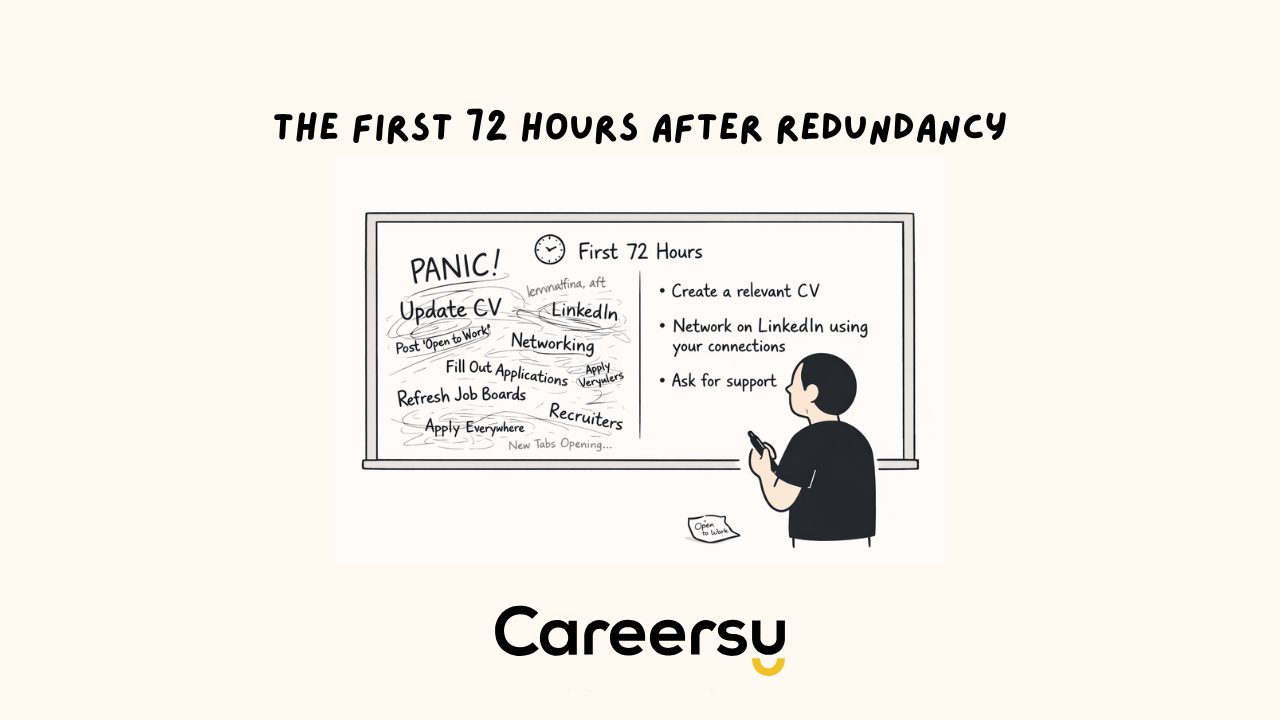
TL;DR (12 to 15 minute read). You were not deleted. Your role was. Most layoffs right now are structural. AI compresses workflows, automation reduces coordination, and investors reward efficiency over expansion. If twelve people plus a few well-designed systems can now do the work of seven, the spreadsheet wins. That is math, not morality.
The mistake most people make in the first 72 hours is motion. Updating the CV, applying everywhere, posting "Open to Work" and hoping velocity equals safety. It feels productive. It is not strategic. Slow down and design the next moves instead.
Work out the specific problems you are consistently good at solving, then connect them to something businesses pay for: revenue, reduced risk, retained customers. Pick one or two clear lanes rather than trying to represent everything you have ever done. Study real job descriptions and shape your CV to show proof you have solved those exact problems before. Choose specific companies instead of applying everywhere, and get a warm introduction before you submit. And decide in advance how you will explain the redundancy, so you are not improvising when the question lands.
You are not starting over. You are repositioning your leverage in a system that just changed its rules. Those are different games, and the first 72 hours decide which one you play.
Key takeaways
- Your role was eliminated for structural reasons: AI compression, efficiency targets, budget math. It is not a verdict on your capability.
- The most common first-72-hours mistake is motion without strategy: applying everywhere before you know what you are offering the market.
- Your most valuable asset is not your title, it is the specific, recurring problem you reliably solve. Identify that first.
- Broad applications make you interchangeable. A targeted list of 20 companies with warm introductions beats 200 cold applications.
- How you frame the redundancy decides whether you signal stability or need. Design the answer before you are asked.
- If you can tie your work to revenue, risk, or retention in one clear sentence, you become much harder to overlook.
The call lasted four minutes. I know because I checked afterward. During it I was nodding, saying "I understand" and "that makes sense," while my brain quietly detached and floated somewhere near the ceiling.
There was a phrase about restructuring. Another about strategic focus. And then, very calmly: "Your role has been made redundant."
It is a strange sentence. It does not accuse you of anything. It does not praise you either. It just removes you from the equation. And afterward your brain does what brains do under threat, it runs forensic analysis. Was this my fault? Did I miss signals? Should I have learned AI faster? Is everyone else quietly ahead? That spiral is normal. It is also not strategic.
So zoom out. A large share of layoffs right now are structural. AI is compressing workflows, automation is reducing coordination, investors are rewarding efficiency over expansion. Companies that hired for scale are now hiring for margin. If something that took twelve people in 2021 can be handled by seven plus a few AI workflows, the math wins. That does not make you obsolete. It means the equation changed, and when the equation changes, reacting emotionally is understandable but responding structurally is more useful.
The first 24 hours: resist the motion
Most people respond with activity. Update the CV, apply everywhere, post "Open to Work." It feels stabilising, it gives you something to do, it creates the illusion of control. But activity and leverage are not the same thing.
When I coach someone in the first week after redundancy, I do not let them apply immediately. Not because they should not, but because they do not yet understand what they are in the market. Job titles disappear overnight. Patterns do not.
Ask someone what they did in their last role and you usually get a list. Managed X. Led Y. Coordinated Z. That is documentation language, and the market does not pay for responsibilities. It pays for problems being removed. So I narrow it down with three deceptively simple questions: what did you actually do, what were you responsible for, and what measurable impact did you have. The first two come quickly, almost rehearsed. Then I ask about impact, and there is usually a pause. Not dramatic. Just long enough for something to shift.
What is dawning on them is not that they lacked impact. It is that they have never been forced to define it in economic terms. Inside a company you can survive on context, everyone already knows what you do. The market does not. So I ask: if I removed your name from that team, what would have gotten worse, slower, riskier, more expensive? That is when the real answer arrives. "Whenever enterprise deals stalled, I got pulled in." "When onboarding broke, I redesigned it." "I was the person people went to when leadership needed a decision turned into execution." Not a title. A pattern. Not responsibilities. Leverage.
Focus beats breadth
Then comes the tension: "but I did a lot of things." Yes. That is the problem. Inside a company, being the multi-tool utility player is an asset. In a job search it becomes blur. If your CV reads like three careers sharing one document, the hiring manager, the recruiter, even the ATS has to work to understand you, and in a cautious market nobody volunteers for extra cognitive load.
So pick one lane, maybe two. Not because the others are not real, but because signal beats breadth. You are not deleting your past, you are choosing your entry point.
Then an assignment: find four job descriptions you genuinely align with, not stretch roles, ones you could step into tomorrow and perform. Read them closely. What language repeats? What outcomes do they emphasise? What problems are they clearly trying to solve? The shift happens when you stop asking "how do I describe myself?" and start asking "what are they trying to fix?" Your CV is not a historical archive. It is a response document. If you cannot map what you have done to the problem the role is solving, you blend in with the capable-but-vague majority, and the market defaults to the candidate who already looks like the obvious match.
That rejection line, "we've decided to move forward with candidates whose experience more closely aligns," rarely means you were not good. It means you were not obvious.
Companies think in money
Here is the part people do not love, and honestly nor do I. My brain does not wake up thinking in revenue and margin. But companies do. Organisations under pressure cut the roles furthest from revenue, retention, or risk. That is not cruelty, it is budgeting, and AI has sharpened the lens because anything repeatable or loosely defined now gets examined for whether it can be automated or done with fewer people.
So instead of "was I valuable?" ask something more precise: could an executive defend my role in one sentence tied directly to money? If that makes you slightly uncomfortable, good. Most people describe outputs, "I built," "I managed," "I implemented." Executives think in outcomes, increased revenue, reduced churn, shortened sales cycles, lowered risk. The work can be identical. The framing changes the altitude, and the altitude often decides whether your role looks essential or optional when the spreadsheet gets tight.
Target, do not spray
Urgency will tell you to apply everywhere and let something stick. It sounds logical. It also turns you into a lottery ticket, because when you apply everywhere you stop being specific, and when you stop being specific you become interchangeable.
Instead, write down 20 companies. Ten you would genuinely love, ten you would seriously consider. Real names, not "anywhere hiring." If you cannot list twenty, that is not failure, it just means you do not have direction yet, and direction matters more than volume. Then go company by company, look at the actual roles, open LinkedIn, search the company, click People, and filter by first-degree connections. That is where leverage already lives.
One important detail: do not apply first and then ask for a referral. In many companies, once you apply through the portal you are logged as a standard applicant, and a later referral may not register properly. Reverse the order. Reach out, secure the referral, then apply. Small sequencing choice, big difference. Cold applications are not useless, just noisy, especially when hundreds of capable people were laid off the same quarter. Warm introductions shift the probabilities. If you want the exact warm-introduction system, scripts and sequencing included, I broke it down in the Careersy Connection Framework.
Borrow the market's language
Message five to seven people you worked with closely and ask: when you think of me at my best, what stands out? You are not fishing for praise, you are looking for patterns. If several people independently say "calm under chaos" or "simplifies complexity" or "builds trust fast with enterprise clients," that is signal. You do not fully control your professional reputation, the market co-authors it, so use its language. It will sound more grounded because it is.
Your first LinkedIn post is a positioning document
Most redundancy posts read like goodbye speeches: grateful, reflective, vague. Socially appropriate, strategically weak. Your first public post is not about closure. It should communicate your scope (years, domain, geography), what you have delivered, what you are specifically strong at, and what you are aiming for next. The market responds to clarity, not need. You can add controlled humanity, "Was this expected? No. Was it personal? Also no. It was math." That line signals stability, and stability is rare in moments like this. Rare signals travel.
Explaining it in an interview
You will be asked what happened. If you have not designed the answer, adrenaline will improvise one. Keep it to three beats: context, impact, direction. "My role was eliminated as the company shifted toward AI-driven automation. I was leading X and had just delivered Y. I am now focused on roles where solving Z is central." Calm, forward-facing, no emotional leakage.
AI is not magic, it is leverage. It rewards people who design systems and solve expensive problems, and it squeezes work that is repetitive, loosely defined, or disconnected from economic outcomes. If your last role leaned on execution without clear business linkage, the market may reprice it. That is not a moral judgment, it is structural change. Redundancy feels like rejection. Most of the time it is reallocation. The real question is not "who is hiring?" It is narrower: what problems do I reliably solve, what proof do I have that I have solved them before, and which roles are actively paying to fix them. The first 72 hours feel chaotic. They are actually design time.
Frequently asked questions
How long does it take to find a job after redundancy in Australia? It varies with seniority, industry, and how targeted your search is. For mid-to-senior tech professionals, a focused search using warm introductions and a clearly positioned CV typically takes 6 to 14 weeks. A spray-and-pray approach can stretch to six months or more, at much higher emotional cost. The biggest variable is clarity: candidates who know exactly what they offer, and to whom, move faster.
Should I post about being made redundant on LinkedIn? Yes, but design the post rather than react. Treat it as a positioning document, not a farewell. Communicate your scope, what you have delivered, what you are strong at, and what you are targeting. Avoid vague "open to opportunities" language. The market responds to clarity and signals of stability, not need.
How do I explain redundancy in a job interview? Use context, impact, direction. "My role was eliminated in a restructure driven by AI automation. Before leaving I had just delivered [outcome]. I am now focused on roles where [problem you solve] is central." Keep it under 30 seconds. Calm and forward-facing reads as resilience, which is what they are assessing.
Is it worth applying for jobs immediately after being made redundant? Not before the positioning work. Applying immediately feels productive but burns your highest-attention window. If your CV does not clearly say what you offer, you have spent that first impression poorly. Use the first 24 to 72 hours to define your pattern and value first.
What is the difference between being made redundant and being fired? Redundancy means the role was eliminated, through restructuring, automation, budget, or strategy. It is not a performance outcome. Being fired is about an individual's performance or conduct. The distinction matters in interviews: redundancy carries no stigma when explained calmly, and is widely understood given the volume of tech layoffs since 2022.
How do I update my CV after redundancy? Start with positioning, not formatting. Before you touch a bullet, identify the specific problem you solve and your evidence for it. Then rewrite your most recent role around measurable outcomes, not responsibilities. Your CV is a response document, not an archive, and it should map directly to the problems your target roles are trying to solve.
Should I use a career coach after redundancy? It can accelerate things if you engage one at the right stage, before you start applying. The most valuable work is in positioning: identifying your pattern, defining your value in economic terms, and building a targeted company list. Coaching is less useful, and more expensive, if you bring someone in after weeks of unsuccessful applications, because you are then unwinding negative signal already in the market.
What about my redundancy payout and finances while searching? Outside the scope of coaching, but the framing matters: knowing your runway removes urgency, and urgency is the enemy of targeting. With three to six months of runway you can be selective. With less, the priority is building your pipeline quickly, which is exactly where a targeted approach beats volume. For redundancy entitlements in Australia, Fair Work Australia is the authoritative source.
New here? Welcome. Eli is the founder of Careersy Coaching, a practice specialising in tech professionals navigating job searches, career transitions, and redundancy. With a background working inside the hiring process, Eli has coached hundreds of candidates into roles at companies across Australia and internationally, with a focus on helping people move faster by being more targeted, not busier. The whole approach rests on one idea: clarity about what you offer the market is the thing that actually accelerates a search.
Stay Sharp Between Applications
Join 1,000+ ambitious tech pros and get one practical, recruiter-backed career tip every Sunday to help you land interviews, negotiate offers, and grow in your role.
No fluff. No spam. Just real advice from inside the hiring room.
We hate SPAM. We will never sell your information, for any reason.